
Have you heard of Futures Literacy? Today’s kindergarteners will turn 80 in the year 2100. They will experience unimaginable technological advances and world events over the next seven and a half decades. What are the educational experiences we can give to prepare them for healthy, fulfilling lives in 2065, 2075, or 2085?
The future can feel daunting, especially within the context of rapidly evolving technology. That’s where futures literacy can help. Created and defined by UNESCO as “an essential competency of the 21st Century,” Futures literacy is the skill of imagining possible futures to better understand the present and make more informed decisions. Futures literacy isn’t about predicting the future or forecasting, but about exploring a range of possibilities and understanding how different futures are shaped by present actions.
As educators, we have a powerful opportunity to shape the future by educating the people who will live it.
The Future of Work
We can explore many possible futures. In education, the future of work is important as we try to equip students for employment upon graduation. According to the World Economic Forum, the top 10 fastest-growing skills expected by employers by 2030 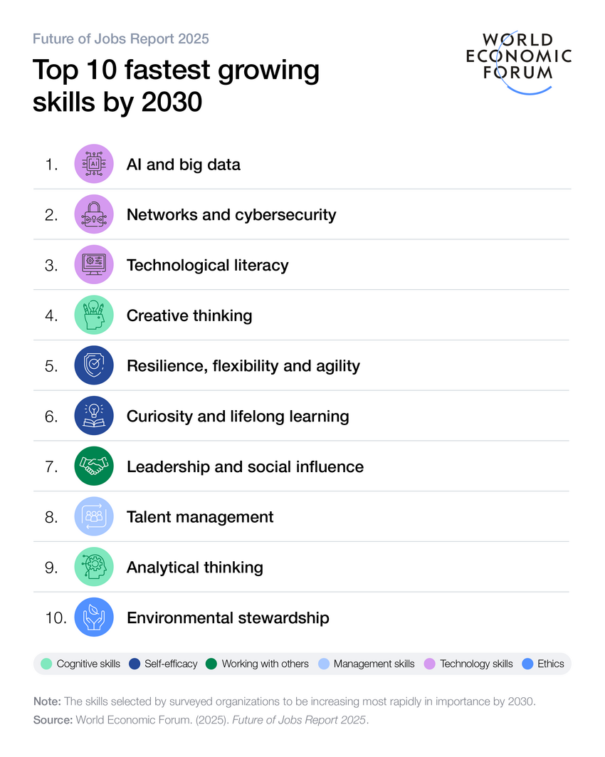 include skills such as AI literacy, creative thinking, resilience, and leadership. Ensuring that students have these skills and the ability to acquire new skills as job market demands shift is a responsibility of our education system.
School districts are investing in AI literacy for teachers and students. Many have adopted a Portrait of a Graduate or Learner Profile to promote competencies and skills beyond the core curriculum. Despite our efforts in education, employers still tell us that young adults are unprepared for the workforce, as documented in the NACE 2024 Student Survey and Job Outlook 2025 survey and YouScience’s 2024 Workforce Report.
Through the lens of futures literacy, we can begin to plan for unknown job market shifts and prepare students for the roles that don’t yet exist. In education, school districts and organizations across North America, including Advanced Learning Partnerships, are recognizing this changing landscape and advocating for high school redesign as the path for building a better future.
Why High School Redesign Matters Now
We know that teacher-directed instruction and high-stakes testing environments are not helping students acquire and demonstrate the competencies aligned to curricular content or future-ready skills. For decades, education leaders have attempted to leverage new technology to strengthen and personalize student learning. Teachers, schools, and districts have seen varied success when implementing new learning initiatives. Often, innovation fails because the current system in place inhibits change rather than supports it.
ALP has supported successful high school redesign for many years. Examples include an ongoing partnership with Kennett Consolidated School District in Pennsylvania and historically with Evergreen Public Schools in Washington state. When districts feel an urgency for change, involve all stakeholder groups, and commit to a clear vision, powerful system transformation begins.
But not all communities are open to transformation. According to the 2024 Gallup poll, 73% of respondents were dissatisfied with public schools. In contrast, 70% of K-12 parents said that they were satisfied with their child’s local education. Public perception of K-12 education in the United States is low, presumably due to a steady stream of news stories highlighting poor performance, absenteeism, teacher shortages, students’ mental health, etc. Still, many parents don’t want their local school systems to change.
So while the public narrative often calls for transformation, local communities frequently prefer familiarity.
That tension raises a critical question: How can we lead educational initiatives that balance stability with radical change?
We know that teacher-directed instruction and high-stakes testing environments are not helping students acquire and demonstrate the competencies aligned to curricular content or future-ready skills.
Futures Protocols: Tools for Navigating What’s Next
By employing futures literacy, districts can reframe the present, foster innovation, and build resiliency while developing new strategies and solutions for complex challenges. The following futures protocols can help districts and communities align around a shared vision, uncover what’s holding them back, and build toward their desired future.
The Futures Triangle: Balancing Past, Present, and Future
The Futures Triangle, explained by futurist Dr. Tuomo Kuosa, helps individuals or organizations identify plausible futures by examining three forces: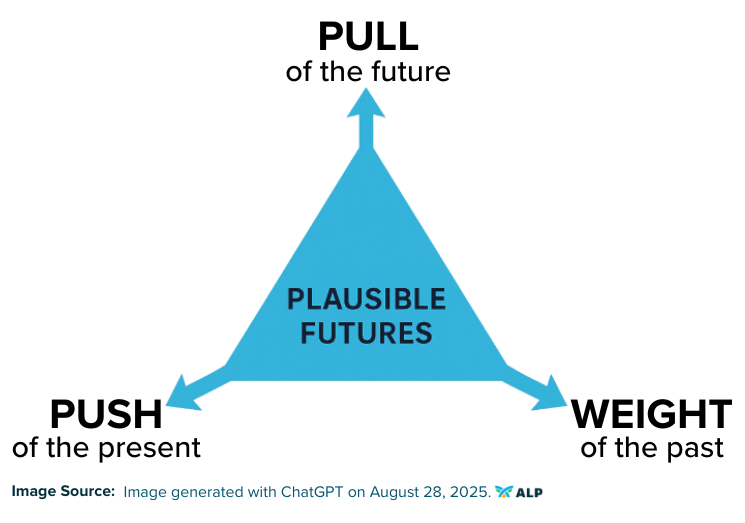
- The pull of the future–the vision we aspire to
- The push of the present–the pressures and trends driving change
- The weight of the past–the traditions that hold us in place
For many school districts, the push of the present is the impact that generative AI and rapidly scaling technology are having on education and our world. Students have access to tools that can quickly and impressively complete their work for them. Communities are managing this rapid technological advancement with both fear and excitement.
In classrooms, the weight of the past includes structuring schedules around seat time, assigning completion grades, and learning progressions requiring all students to learn the same content at the same pace. These traditional systems of education disconnect the classroom from the world outside of school. Some crucial stakeholders, like teachers, school boards, and parents, advocate for kids to have the same educational experience they had, or are wary of change because they experienced or witnessed failed initiatives.
The pull of the future will have to be defined together. Different communities have different dreams, which is okay! A wise approach to envisioning a future state involves student participation, valuing the well-being of every person in the education system, and striving to create a rigorous learning environment that fosters high skill attainment.
What would your district’s “pull of the future” look like if students helped define it?
Completing this futures triangle around a chosen topic with a mixed group of stakeholders could help the community develop a shared vision for the future and name the forces associated with accomplishing these goals.
The Three Horizons Framework: Seeing Change as a Journey
The Three Horizons Framework creates a shared vision of a new system by naming the three phases in the lifespan of a system.
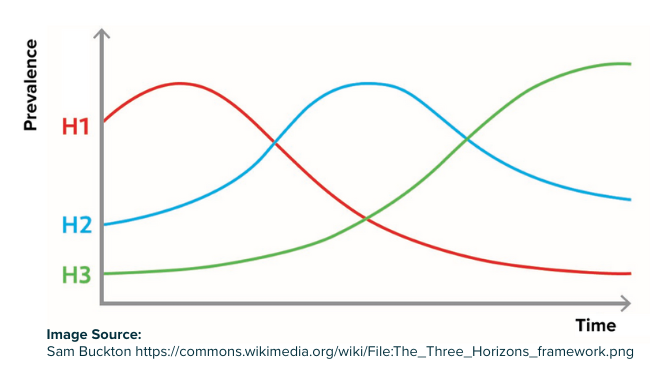 According to New Philanthropy Capital (NPC):
Horizon 1 represents the current system-business as usual.
Horizon 2 represents the innovation(s)–experiments and pilots that move us toward something new.
Horizon 3 represents the desired future state–the system we aspire to create.
Shifting from one horizon to another isn’t instantaneous. It’s a gradual, iterative process.
In the case of generative AI, for example, many districts are adopting AI policies and guidelines, developing AI fluency among students and teachers, and reconsidering curriculum design and assessment. These are all Horizon 2 efforts—transitional steps toward the future system (Horizon 3). Think of Horizon 2 as what we experiment with, pilot, or prototype on the way to Horizon 3. Just because there is a lot of focus and energy toward integrating AI into schools doesn’t mean that districts have reached their desired state, or have even defined what they imagine it will look like.
An imagined vision for Horizon 3 with generative AI in schools might include: a fully developed curriculum that teaches students about responsible and ethical use of AI; students and teachers using AI with agency, explaining why they used it, how it helped them, and where their own critical thinking was necessary in the process; assessments that allow students to demonstrate their learning while leveraging technology to improve their artifacts; administrators using prompts and AI processes to increase efficiency and improve school systems; and district teams leveraging AI innovations that have a positive impact on the learning and wellbeing of their students and staff.
When used as a protocol, a group would begin by defining Horizon 3. To embark on any initiative, including technology adoptions, curricular and pedagogy changes, student and staff wellbeing, etc., it is helpful for all stakeholders to dream of the desired state together. Then, participants would name where they are right now, for Horizon 1. From there, you can tackle Horizon 2 by identifying the innovations that will lead you to Horizon 3.
The Futures Wheel: Anticipating Ripple Effects
Once we’ve considered the push/pull/weight of our system (Futures Triangle) and painted the phases of change (Three Horizons), the Futures Wheel helps us anticipate ripple effects.
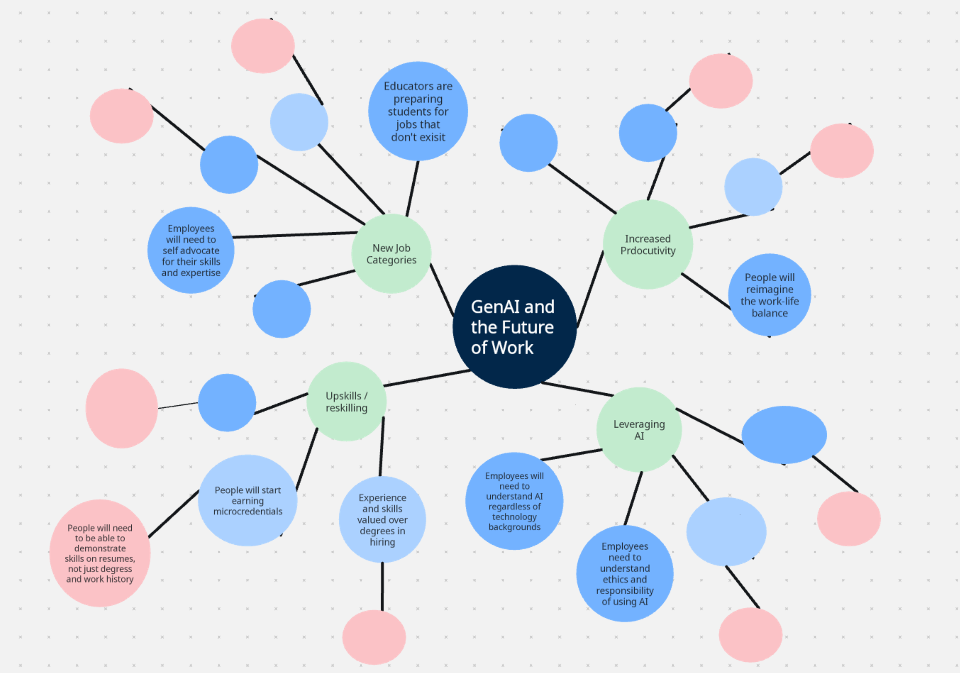
The Futures Wheel, developed in the 1970s, helps visualize the ripple effects of a decision, trend, or event. It begins with a central change—such as Generative AI and the Future of Work—and radiates outward through layers of consequences:
- First-order effects (direct consequences)
- Second-order effects (indirect consequences)
- Third-order effects (long-term implications)
For example, the immediate consequence of AI and work might be the need for upskilling or reskilling employees. The second-order effects could include experience and skills demonstration being valued over degrees. The third-order effects might be the need for skill demonstration on resumes.
The wheel shown here is incomplete, but it shows how each consequence of a change has corresponding consequences that follow.
As a team exercise, a whole group would brainstorm first-order consequences for the identified topic. Those would be added to a shared collaboration space, such as a Zoom Whiteboard or physical wall. Then, participants would break into small groups to explore the second and third-order consequences for their assigned first-order consequence. Finally, the whole group would reconvene to understand the implications for the possible futures.
When your district launches a new initiative, what might its second–and third–order effects be?
Helping Communities Unlearn the Past
One important step in leading systems change and realizing a desired future state involves helping our communities unlearn Horizon 1 and let go of the “weight of the past.”
In Doughnut Economics, Kate Raworth explains how important images, diagrams, and illustrations are for learning. She also explains how difficult it is to unlearn something we’ve attached an image to, even when presented with compelling scientific evidence. She created a new illustration of a 21st-century economics model precisely because the old diagrams were so deeply embedded in people’s minds.
The same is true in education. It is hard for people to envision and/or accept change because they don’t have a visual representation of the proposed transformation to ground their thinking.
What are the old pictures we still hold onto—classrooms with rows of desks facing forward, GPAs as ultimate measures of learning, four-year college as the aspirational postsecondary path?
And what new images might replace them to understand and communicate new models of education that serve our students, communities, and world?
Building the Future – Together
Systems-wide change is complex. It takes more than research-based innovations and good intentions. It requires a purposeful unlearning of the familiar way of doing things and a collective willingness to move toward what’s next, together. It means listening deeply to stakeholders, co-creating visions, honoring every voice in the room, and staying committed when uncertainty arises.
The Futures Triangle, Three Horizons Framework, and The Futures Wheel are practices that help us imagine what’s possible, name what’s holding us back, and plan for the journey ahead. If we want our students to thrive in the world that’s coming, not the one that’s past, we must practice futures literacy and imagine possible paths forward.
What would it look like for your school, district, or community to try one of these protocols?
The future isn’t something we wait for; it’s something we imagine, plan for, and build together.
Rachel Fruin is ALP’s Director of Professional Learning and author of the blog Teaching in the Age of AI: What Educators Need to Know and Why It Matters. A former high school Math teacher, Rachel brings an innovative mindset to designing professional learning experiences. She is dedicated to partnering with educators in today’s complex learning environment and equipping them to draw on their expertise and strengths to develop practical solutions that make a meaningful difference for students and the broader community. Follow Rachel on LinkedIn
View Rachel’s conversation with ALP President and Founder, Amos Fodchuk, about the power of data at all levels of education: Data-Informed Decisions: Creating a Culture for Effective Data Practices
AI Transparency Statement: AI was used to review and revise this article for clarity, conciseness, and applicability. AI was also used to generate images.
ALP helps districts to prepare for and execute system-wide change at multiple levels. We lead educators in creating customized district learner profiles with aligned learner progressions, enabling leaders to communicate a clear vision for student success. Through Executive Consulting, we support learner-centered models and proven leadership strategies that promote co-owned, sustained growth over time. Our Coaching approach delivers personalized support, clear goals, and a structured process for individuals and teams to achieve their objectives. Let ALP help your district through future-focused strategies and support.
References
Advanced Learning Partnerships. (n.d.-a). High school design thinking case study. ALP Learn. https://alplearn.com/story/high-school-design-thinking-case-study/
Advanced Learning Partnerships. (n.d.-b). High school redesign. ALP Learn. https://alplearn.com/story/high-school-redesign/
Berliner, D. C. (2011). Rational responses to high-stakes testing. Global Conversations in Literacy Development. https://globalconversationsinliteracy.wordpress.com/wp-content/uploads/2014/08/berliner-d_2011_rational-responses-to-high-stakes-testing.pdf
Futures Platform. (2021, September 23). How can we predict plausible futures? https://www.futuresplatform.com/blog/how-can-we-predict-plausible-futures
Gallup. (2024, August 8). Satisfaction with U.S. public education reaches record low in new Gallup survey. The 74 Million. https://www.the74million.org/article/satisfaction-with-u-s-public-education-reaches-record-low-in-new-gallup-survey/#:~:text=Previous%20Gallup%20surveys%20over%20the,the%20nation’s%20education%20system%20overall
National Association of Colleges and Employers (NACE). (2024, April 24). The gap in perceptions of new grads’ competency proficiency — and resources to shrink it. https://www.naceweb.org/career-readiness/competencies/the-gap-in-perceptions-of-new-grads-competency-proficiency-and-resources-to-shrink-it
NPC. (n.d.). The three horizons framework. In Systems practice toolkit. https://www.thinknpc.org/resource-hub/systems-practice-toolkit/the-three-horizons-framework/
Raworth, K. (2017). Doughnut economics: Seven ways to think like a 21st-century economist. Chelsea Green Publishing.
Schweder, S., Grahl, L., & Raufelder, D. (2025). Examining self-directed and teacher-directed learning’s impact on achievement goals and learning strategies. The Journal of Experimental Education, 1–26. https://doi.org/10.1080/00220973.2025.2459382
UNESCO. “About — Futures Literacy: An Essential Competency for the 21st Century.” UNESCO, 2025, https://www.unesco.org/en/futures-literacy/about.
Visual Paradigm. (n.d.). What is futures wheel? https://online.visual-paradigm.com/knowledge/decision-analysis/what-is-futures-wheel/
Wikipedia contributors. (2019, June 4). The Three Horizons framework [Image]. Wikimedia Commons. https://commons.wikimedia.org/wiki/File:The_Three_Horizons_framework.png
World Economic Forum. (2025). The future of jobs report 2025: Infographics. https://www.weforum.org/publications/the-future-of-jobs-report-2025/infographics-94b6214b36/
YouScience. (2024). 2024 workforce report. https://resources.youscience.com/rs/806-BFU-539/images/2024_WorkforceReport.pdf

